


A Franciscan Gospel Reflection for the Third Sunday of Easter 2026 is shared here for your prayer. Where do you go when you are stressed or disappointed? Are you more likely to be talkative or shut down internally in those situations?
The Gospel background and reflection questions are prepared and distributed by Franciscan Sister of Christian Charity Sister Anne Marie Lom, OSF and Joe Thiel, as edited from Reflections authored by Fr. Paul Gallagher, OFM. The excerpts from the Sunday readings are prepared by Joe Thiel. To read or download the complete pdf with excerpts for your prayer, please click here: Franciscan Gospel reflection April 19 2026
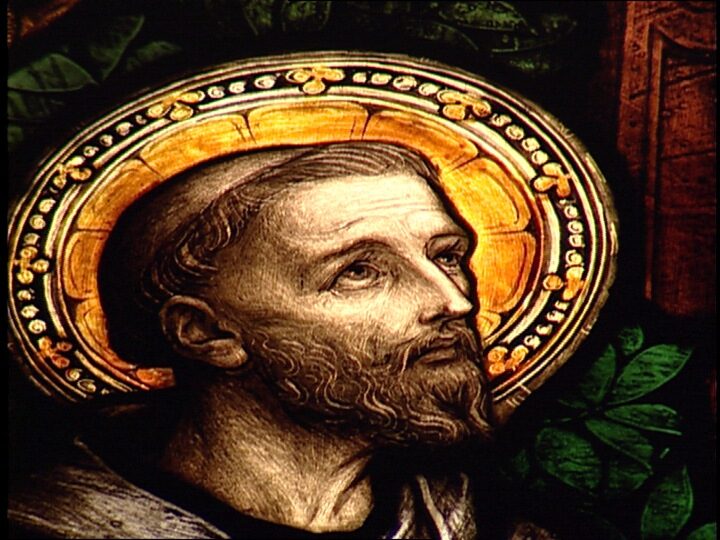
Photos: Nheyob, CC BY 4.0 <https://creativecommons.org/licenses/by/4.0>, via Wikimedia Commons;
Luke 24:13-35
Now that very day, the first day of the week, two of them were going to a village seven miles from Jerusalem called Emmaus, and they were conversing about all the things that had occurred. And it happened that while they were conversing and debating, Jesus himself drew near and walked with them, but their eyes were prevented from recognizing him. He asked them, “What are you discussing as you walk along?” They stopped, looking downcast. One of them, named Cleopas, said to him in reply, “Are you the only visitor to Jerusalem who does not know of the things that have taken place there in these days?” And he replied to them, “What sort of things?” They said to him, “The things that happened to Jesus the Nazarene, who was a prophet mighty in deed and word before God and all the people, how our chief priests and rulers both handed him over to a sentence of death and crucified him. But we were hoping that he would be the one to redeem Israel; and besides all this, it is now the third day since this took place. Some women from our group, however, have astounded us: they were at the tomb early in the morning and did not find his body; they came back and reported that they had indeed seen a vision of angels who announced that he was alive. Then some of those with us went to the tomb and found things just as the women had described, but him they did not see.”
And he said to them, “Oh, how foolish you are! How slow of heart to believe all that the prophets spoke! Was it not necessary that the Messiah should suffer these things and enter into his glory?” Then beginning with Moses and all the prophets, he interpreted to them what referred to him in all the scriptures. As they approached the village to which they were going, he gave the impression that he was going on farther. But they urged him, “Stay with us, for it is nearly evening and the day is almost over.”
So he went in to stay with them. And it happened that, while he was with them at table, he took bread, said the blessing, broke it, and gave it to them. With that their eyes were opened and they recognized him, but he vanished from their sight. Then they said to each other, “Were not our hearts burning within us while he spoke to us on the way and opened the scriptures to us?” So they set out at once and returned to Jerusalem where they found gathered together the eleven and those with them who were saying, “The Lord has truly been raised and has appeared to Simon!” Then the two recounted what had taken place on the way and how he was made known to them in the breaking of the bread.

Background:
This familiar Gospel must be one of the preferred post-resurrection Gospels of the Church, for how often it is presented. It was one of the possible texts for Easter Sunday, it was the Gospel for the Wednesday after Easter, and it is the one for this, the third Sunday of Easter during year A of the Liturgical cycle.
The early disciples were disappointed and humiliated by the fact that Jesus was crucified, a form of execution so painful and humiliating it was reserved for the most notorious of wrongdoers. Last Sunday’s Gospel also indicated that the disciples were afraid for their own safety. It should be no surprise that some of the disciples gathered behind locked doors and others gave up hope and fled. The two disciples that were on the road to Emmaus were likely pilgrims who had come to Jerusalem to celebrate Passover, and they were likely on their way home. In this encounter, they are able to describe the events of the crucifixion, and they speak of their hope that Jesus might be the long-awaited savior of Israel. But the events of the day are the report of some women that morning who found the tomb empty where Jesus had been buried, and received a vision of angels, and others verifying the report of the empty tomb but not the angels or Jesus himself. These two seem to have given up their hope in Jesus and even separated themselves from the other disciples, and they are now returning home.
Despite that fact that they are disciples, they do not recognize Jesus physically or theologically. Jesus brings to them a new understanding of their tradition that enables them to see how his rejection, crucifixion, and death were in accord with their scriptures. Even with that insight, they still do not recognize Jesus. It is not until the breaking of the bread that they recognize Jesus, the risen Lord. This breaking of bread is deliberately described in a way that parallels the description of the Last Supper. But as soon as they recognize him, he disappears from their sight. They return immediately to Jerusalem to report to the disciples their experience, and they hear of the other experiences of the risen Lord.
Reflection Questions:
1. Where do you go when you are stressed or disappointed? Are you more likely to be talkative or shut down internally in those situations?
2. Has there been a period in your life when you were disappointed, frustrated, or even overwhelmed with a sense that God was not present, or was non-responsive?
3. How have distant wars and struggles or up-close personal and family issues affected your awareness of God’s presence?
4. Have you ever had a sense that God was walking with you? If so, did you have that awareness during that point of your life, or only later? When Jesus drew near and walked with the two disciples, their eyes were prevented from recognizing him. Does that say anything to you about how God desires to be present to you?
5. When the two disciples recognized Jesus, he disappeared. How do you understand this part of what Luke is telling us who read his Gospel?
6. The two disciples stated that the chief priests and rulers had handed Jesus over to be crucified, but they were hoping that Jesus would be the one to redeem Israel. Have you ever held hopes that were at odds with the civic or religious leaders? Why would Luke include this statement in his account of the situation?
7. Can you take some time now to talk with God honestly about whatever thoughts or feelings arose within you from this text? Or maybe you would like to talk with God about how other events have disturbed your understanding of how God would like to be present in your world or your life?
The post Third Sunday of Easter 2026 Franciscan Gospel Reflection appeared first on Franciscan Sisters.